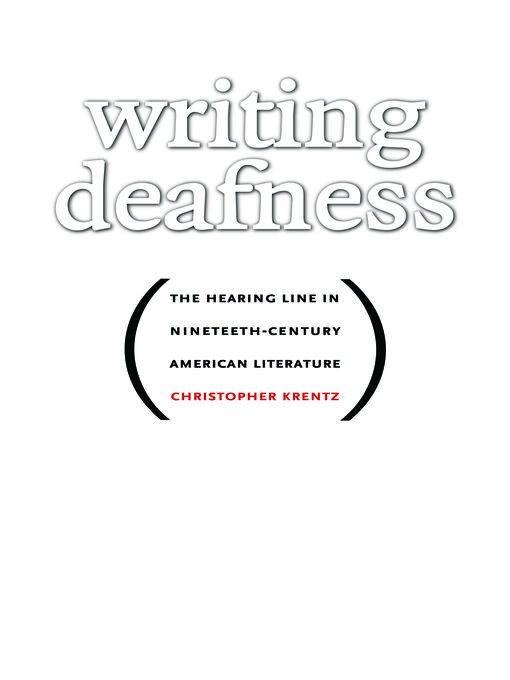
Taking an original approach to American literature, Christopher Krentz examines nineteenth-century writing from a new angle: that of deafness, which he shows to have surprising importance in identity formation. The rise of deaf education during this period made deaf people much more visible in American society. Krentz demonstrates that deaf and hearing authors used writing to explore their similarities and differences, trying to work out the invisible boundary, analogous to Du Bois’s color line, that Krentz calls the “hearing line.”
Writing Deafness examines previously overlooked literature by deaf authors, who turned to writing to find a voice in public discourse and to demonstrate their intelligence and humanity to the majority. Hearing authors such as James Fenimore Cooper, Lydia Huntley Sigourney, Herman Melville, and Mark Twain often subtly took on deaf-related issues, using deafness to define not just deaf others, but also themselves (as competent and rational), helping form a self-consciously hearing identity. Offering insights for theories of identity, physical difference, minority writing, race, and postcolonialism, this compelling book makes essential reading for students of American literature and culture, deaf studies, and disability studies.
-
Creators
-
Publisher
-
Release date
September 1, 2012 -
Formats
-
Kindle Book
-
OverDrive Read
- ISBN: 9781469606682
- File size: 2799 KB
-
EPUB ebook
- ISBN: 9781469606682
- File size: 2799 KB
-
-
Accessibility
-
Languages
- English
Formats
- Kindle Book
- OverDrive Read
- EPUB ebook
subjects
Languages
- English
Why is availability limited?
×Availability can change throughout the month based on the library's budget. You can still place a hold on the title, and your hold will be automatically filled as soon as the title is available again.
The Kindle Book format for this title is not supported on:
×Read-along ebook
×The OverDrive Read format of this ebook has professional narration that plays while you read in your browser. Learn more here.