Association of Recorded Sound Collections Awards for Excellence
Best Historical Research in Recorded Blues, Gospel, Soul, or R&B–Certificate of Merit (2018)
2023 Blues Hall of Fame Inductee - Classic of Blues Literature category
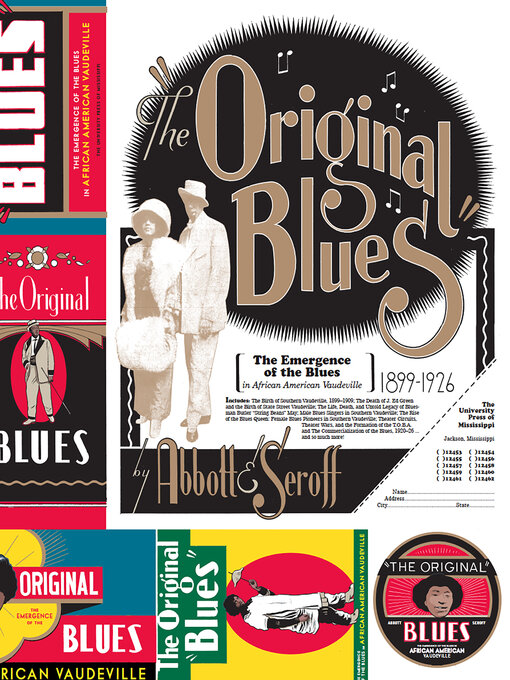
With this volume, Lynn Abbott and Doug Seroff complete their groundbreaking trilogy on the development of African American popular music. Fortified by decades of research, the authors bring to life the performers, entrepreneurs, critics, venues, and institutions that were most crucial to the emergence of the blues in black southern vaudeville theaters; the shadowy prehistory and early development of the blues is illuminated, detailed, and given substance.
At the end of the nineteenth century, vaudeville began to replace minstrelsy as America's favorite form of stage entertainment. Segregation necessitated the creation of discrete African American vaudeville theaters. When these venues first gained popularity, ragtime coon songs were the standard fare. Insular black southern theaters provided a safe haven, where coon songs underwent rehabilitation and blues songs suitable for the professional stage were formulated. The process was energized by dynamic interaction between the performers and their racially-exclusive audience.
The first blues star of black vaudeville was Butler "String Beans" May, a blackface comedian from Montgomery, Alabama. Before his bizarre, senseless death in 1917, String Beans was recognized as the "blues master piano player of the world." His musical legacy, elusive and previously unacknowledged, is preserved in the repertoire of country blues singer-guitarists and pianists of the race recording era.
While male blues singers remained tethered to the role of blackface comedian, female "coon shouters" acquired a more dignified aura in the emergent persona of the "blues queen." Ma Rainey, Bessie Smith, and most of their contemporaries came through this portal; while others, such as forgotten blues heroine Ora Criswell and her protégé Trixie Smith, ingeniously reconfigured the blackface mask for their own subversive purposes.
In 1921 black vaudeville activity was effectively nationalized by the Theater Owners Booking Association (T.O.B.A.). In collaboration with the emergent race record industry, T.O.B.A. theaters featured touring companies headed by blues queens with records to sell. By this time the blues had moved beyond the confines of entertainment for an exclusively black audience. Small-time black vaudeville became something it had never been before—a gateway to big-time white vaudeville circuits, burlesque wheels, and fancy metropolitan cabarets. While the 1920s was the most glamorous and remunerative period of vaudeville blues, the prior decade was arguably even more creative, having witnessed the emergence, popularization, and early development of the original blues on the African American vaudeville stage.
-
Creators
-
Series
-
Publisher
-
Release date
February 27, 2017 -
Formats
-
Kindle Book
-
OverDrive Read
- ISBN: 9781496810045
- File size: 68866 KB
-
EPUB ebook
- ISBN: 9781496810045
- File size: 68866 KB
-
-
Accessibility
-
Languages
- English
Formats
- Kindle Book
- OverDrive Read
- EPUB ebook
subjects
Languages
- English
Why is availability limited?
×Availability can change throughout the month based on the library's budget. You can still place a hold on the title, and your hold will be automatically filled as soon as the title is available again.
The Kindle Book format for this title is not supported on:
×Read-along ebook
×The OverDrive Read format of this ebook has professional narration that plays while you read in your browser. Learn more here.